Belgian Malinois are among the most capable protection dogs in the world, trusted by military units, law enforcement agencies, and an increasing number of high-income families seeking real security at home. But capability and family compatibility are not the same thing. Many families are drawn to this breed by its reputation for loyalty and alertness, without fully understanding the temperament, instincts, and daily demands that come with it. This article cuts through the most common misconceptions and gives you a clear, evidence-based picture of what Belgian Malinois family safety actually requires.
Table of Contents
- Understanding Belgian Malinois temperament and instincts
- Safety with children: Supervision, age, and training
- Integrating a Malinois with other pets
- Training, exercise, and why experience matters
- Separating myth from reality: Bite risk, liability, and real-world outcomes
- Our perspective: The uncomfortable truth about Malinois family safety
- Find the right Belgian Malinois for your family’s safety
- Frequently asked questions
Key Takeaways
| Point | Details |
|---|---|
| Not for novices | Belgian Malinois need experienced, active owners and are not a beginner’s breed. |
| Supervision is essential | Never leave young children or other pets unsupervised with a Malinois. |
| Training drives safety | Professional training and continuous engagement are the keys to a safe, happy family dog. |
| Understand real risks | Actual bite risk is low with proper training, but liability and supervision are always required. |
| Preparation is key | Success with a Malinois means honest self-assessment and a commitment to ongoing care. |
Understanding Belgian Malinois temperament and instincts
The Belgian Malinois is a working breed built for sustained physical and mental effort. Intensely loyal, highly alert, and naturally protective, these dogs form deep bonds with their families and take their role as guardians seriously. Those qualities are exactly what make them attractive for personal protection. However, those same traits require careful management in a family environment, particularly around young children and other household animals.
Malinois are not aggressive by default, but they are reactive by nature. They read their environment constantly, respond quickly to perceived threats, and have strong herding and chasing instincts inherited from their pastoral working background. In a calm, structured household with experienced owners, these instincts are an asset. In a chaotic or unprepared home, they can become a liability.
Understanding these Malinois family guard dog traits is the foundation of safe ownership. The breed’s intensity is not a flaw. It is a design feature that demands respect and proper channeling through consistent training and structured routines.
Key temperament traits every family should understand before bringing a Malinois home:
- Loyalty and protectiveness: Malinois bond closely with their primary family unit and will naturally position themselves as protectors.
- High energy and drive: This breed requires significant daily physical and mental stimulation. Without it, frustration builds quickly.
- Herding instincts: Malinois may attempt to herd small children or other pets by circling, nudging, or nipping at heels.
- Sensitivity to environment: Loud, unpredictable environments can trigger reactive responses if the dog is not properly socialized.
- Strong prey drive: Fast-moving animals or children running may trigger chasing behavior that is difficult to interrupt without trained recall.
“With children: Good with older kids (8+), protective; risks herding/nipping young kids; always supervise, never leave alone with toddlers.” Dogster
Similarly, multi-pet integration is possible but requires deliberate socialization from the start. Herding and chasing instincts may cause serious issues with smaller animals if introductions are rushed or unsupervised.
Safety with children: Supervision, age, and training
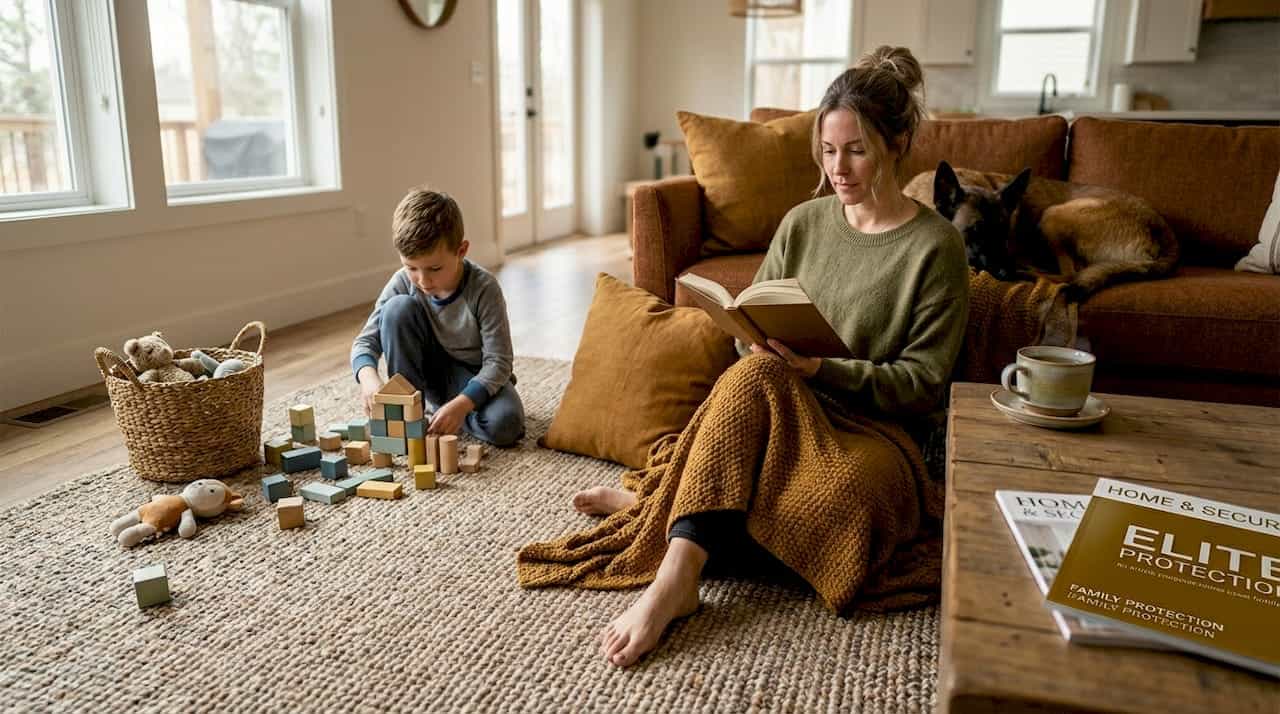
For families with children, the most important variable is age. Belgian Malinois generally do well with children who are eight years old and older, primarily because older kids can follow household rules, read the dog’s body language, and respond appropriately to correction. Toddlers and very young children, by contrast, move unpredictably, make sudden loud noises, and cannot be taught to respect a dog’s boundaries in the same way.
The risks of herding and nipping with young children are real and should not be minimized. A Malinois that has not been specifically trained for calm interaction with small children may interpret a toddler’s erratic movement as something to control or chase. This is not aggression in the traditional sense, but it can result in injury.
Practical guidelines for families with children:
- Establish clear household rules from day one. Children must understand they cannot roughhouse with the dog, pull on ears or tails, or approach the dog while it is eating or sleeping.
- Supervise every interaction between the Malinois and children under ten years old, without exception. Even a well-trained dog should never be left alone with a toddler.
- Create safe zones for the dog where children are not permitted to enter. This gives the dog a place to decompress and reduces stress-related reactions.
- Enroll in family protection dog training that specifically addresses child-safe behavior, not just obedience commands.
- Teach children how to interact with the dog calmly and respectfully. This is as much about child education as it is about dog training.
| Age group | Risk level | Recommended supervision |
|---|---|---|
| Toddlers (0 to 3) | High | Constant, no exceptions |
| Young children (4 to 7) | Moderate to high | Always present, structured interaction |
| Older children (8 to 12) | Moderate | Supervised, with clear rules in place |
| Teenagers (13+) | Lower | Periodic oversight, ongoing training |
Pro Tip: A Malinois that has been professionally trained for family integration will have specific conditioning around child-related stimuli, including sudden movement, high-pitched sounds, and unpredictable behavior. This conditioning significantly reduces the risk of reactive responses around younger children.
Integrating a Malinois with other pets
Bringing a Belgian Malinois into a home that already has cats, smaller dogs, or other animals requires a structured and patient approach. The breed’s herding instincts and prey drive do not disappear with good intentions. They must be actively managed through controlled introductions and consistent reinforcement over time.
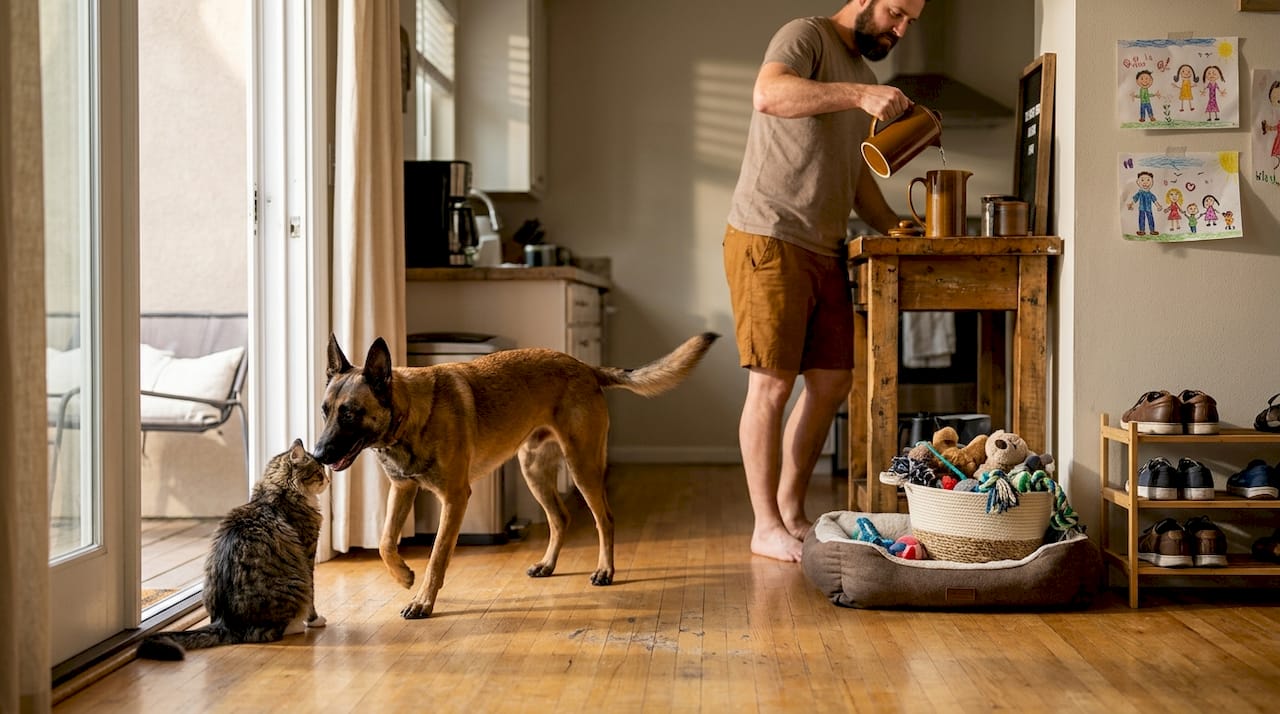
The gradual introduction process is non-negotiable. Rushing this phase is one of the most common mistakes families make, and it often results in incidents that could have been avoided entirely. A Malinois that is introduced to a cat or small dog too quickly, without proper desensitization, may develop a fixed pattern of chasing or intimidation that becomes very difficult to reverse.
Steps for successful multi-pet integration:
- Scent introduction first: Allow the Malinois to smell bedding or items belonging to the other animal before any face-to-face meeting.
- Controlled visual exposure: Let the animals see each other through a barrier such as a baby gate or crate before direct contact.
- Leashed first meetings: Keep the Malinois on a leash during initial introductions so you have immediate control if the dog fixates or lunges.
- Reward calm behavior: Reinforce the Malinois for ignoring or remaining neutral around the other animal, rather than only correcting unwanted behavior.
- Separate feeding areas: Resource guarding can complicate multi-pet households. Always feed animals separately, especially in the early stages.
| Scenario | Risk level | Management strategy |
|---|---|---|
| Malinois with large dogs | Low to moderate | Structured introduction, monitor play style |
| Malinois with small dogs | Moderate | Leashed meetings, separate spaces initially |
| Malinois with cats | Moderate to high | Scent introduction, controlled exposure, safe escape routes for cat |
| Malinois with small animals (rabbits, birds) | High | Strict separation recommended |
For families considering multiple animals, it is worth reviewing best dog breeds for families with pets to understand how a Malinois compares to other protection-capable breeds in terms of compatibility.
Training, exercise, and why experience matters
A Belgian Malinois without adequate daily exercise and mental stimulation is not a calm family companion. It is a source of ongoing behavioral problems. This breed was developed to work eight to ten hours a day alongside handlers in demanding environments. That drive does not switch off simply because the dog lives in a comfortable home.
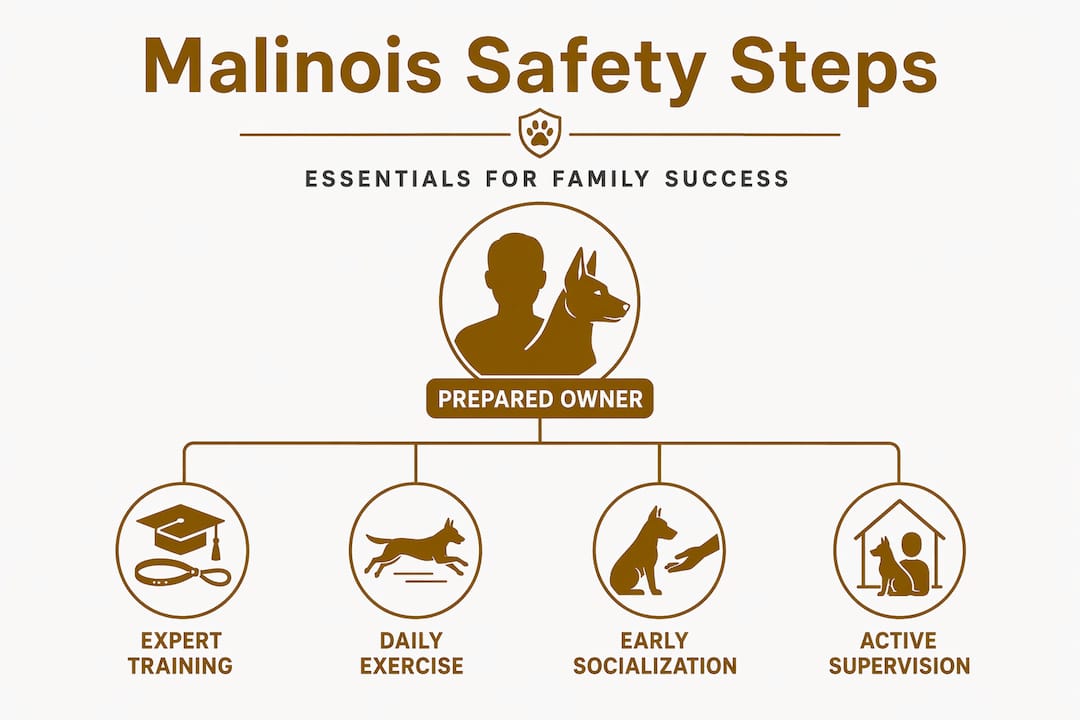
High energy without an outlet leads directly to destructive behavior, anxiety, and in some cases, redirected aggression. Families who underestimate this reality often find themselves overwhelmed within the first year of ownership. The dog’s behavior deteriorates not because it is inherently dangerous, but because its needs are not being met.
A structured daily routine for a family Malinois should include:
- Morning exercise: A minimum of 45 to 60 minutes of vigorous physical activity, such as running, fetch, or structured off-leash work in a secure area.
- Mental stimulation: Obedience drills, scent work, or puzzle-based activities that engage the dog’s working drive without requiring physical exertion.
- Training sessions: Short, focused sessions of 10 to 15 minutes at least twice daily to reinforce commands and maintain responsiveness.
- Structured downtime: Teaching the dog to settle calmly in a designated space is itself a trained behavior that requires consistent reinforcement.
- Evening activity: A second exercise session or long walk to help the dog decompress before the household settles for the night.
“Expert consensus: Professional training is essential for family protection roles; prioritize experienced owners with active lifestyles and resources for ongoing care.” Digital Journal
Protection dog obedience training is not a one-time event. It is an ongoing commitment that requires the owner to remain engaged, consistent, and willing to invest in professional support when needed. The Malinois training journey from early development to reliable family integration typically spans one to two years of structured, hands-on work.
Pro Tip: First-time dog owners should not start with a Belgian Malinois. The breed’s intensity, drive, and sensitivity require an owner who already understands canine communication, can enforce boundaries without conflict, and has the time and resources to meet the dog’s daily needs without compromise.
Separating myth from reality: Bite risk, liability, and real-world outcomes
One of the most persistent fears surrounding Belgian Malinois in family settings is the risk of biting. This concern is understandable given the breed’s association with police and military work, where controlled bite training is part of the job. However, the evidence does not support the idea that Malinois are inherently more dangerous than other large working breeds.
No breed-specific bite benchmarks identify Malinois as a high-risk breed in general household settings. The primary drivers of bite incidents across all breeds are lack of socialization, inadequate training, owner inexperience, and failure to supervise interactions with children. A Malinois that has been properly trained and socialized is not a bite risk in the way that popular media often suggests.
That said, the contrasting views on this breed are worth acknowledging honestly. Positive accounts from experienced owners emphasize the Malinois’s loyalty, protectiveness, and deep bond with family members. Warning voices, equally valid, emphasize the breed’s intensity, the supervision requirements around young children, and the reality that this dog is simply not suited for casual or unprepared ownership.
Key liability and safety considerations for families:
- Homeowner’s insurance: Some insurance providers restrict or surcharge policies for households with certain working breeds. Verify your coverage before bringing a Malinois home.
- Local breed regulations: Some municipalities have restrictions on protection-trained dogs. Understand your local ordinances before making a commitment.
- Documentation of training: A professionally trained dog with documented obedience and temperament records provides legal protection in the event of an incident.
- Liability waivers and guest protocols: Establish clear rules for how the dog behaves around visitors, and consider formal protocols for introducing the dog to new people in the home.
Families who choose a fully trained Malinois for safety rather than attempting to train a green dog themselves significantly reduce their exposure to both behavioral incidents and legal liability. The investment in professional development pays dividends in predictability and peace of mind.
Our perspective: The uncomfortable truth about Malinois family safety
After years of working with high-income families, executives, and parents who are serious about personal protection, one pattern stands out clearly. Most families who experience problems with a Belgian Malinois do not have a dog problem. They have a preparation problem.
The breed itself is not the issue. A well-developed Malinois with documented socialization, structured obedience, and real-world exposure is one of the most reliable family protection dogs available. What creates risk is the gap between what families expect and what they are actually prepared to deliver in terms of time, discipline, consistency, and resources.
Many families are not fully honest with themselves during the decision-making process. They see the breed’s capabilities and imagine the protection benefits without seriously accounting for the daily demands. A Malinois that does not receive adequate exercise becomes anxious. An anxious Malinois in a home with young children is a safety concern regardless of its genetic potential.
The other uncomfortable truth is that shortcuts do not work with this breed. Families who attempt to train a Malinois themselves without professional guidance, or who purchase a dog with minimal documented development, are taking on significant risk. The Elite Malinois case studies we have developed over the years consistently show that dogs with one to two years of structured, hands-on professional development integrate into family life far more successfully than dogs trained quickly or inconsistently.
Expert support is not a luxury for this breed. It is the responsible minimum for any family that wants a Malinois to function safely as both a companion and a protector.
Find the right Belgian Malinois for your family’s safety
Choosing a Belgian Malinois for family protection is a serious decision, and it deserves a serious process. Families who are ready to move forward should begin by exploring available protection dogs developed specifically for family integration, with documented obedience, socialization, and temperament evaluation built into every stage of development.
Understanding the benefits of professional training is the clearest way to see why a professionally developed dog is a fundamentally different investment than a green dog or a dog trained in a short program. Every dog we place has gone through the training journey that produces calm, confident, and reliably safe companions for families with children, other pets, and active lifestyles. When you are ready to invest in genuine peace of mind, we are ready to help you find the right match.
Frequently asked questions
Are Belgian Malinois safe for families with young children?
Malinois can be safe with older children, but they should never be left alone with young kids due to their herding and nipping instincts, as supervision is always required around toddlers.
How can I safely introduce a Belgian Malinois to other pets?
Slow, supervised introductions and consistent socialization are essential, since herding and chasing instincts can cause issues if the process is rushed or unsupervised.
Is training by an expert really necessary for a family Malinois?
Expert training is strongly recommended because high energy without an outlet leads to destructive behavior and anxiety, and this breed’s intensity is not suited for novice owners.
Do Belgian Malinois have a higher bite risk than other breeds?
There is no evidence that Malinois are more likely to bite, as safety depends on training, socialization, and consistent supervision rather than breed genetics alone.
What daily routine does a Malinois require to stay safe and happy?
They need extensive daily exercise, structured mental stimulation, and a consistent environment, since high energy without structure leads directly to anxiety and unwanted behaviors.
Recommended
- Belgian Malinois Guard Dog for Home Protection | 5 Reasons to Choose
- Top 5 Breeds to Consider as the Best Home Protection Dog Companions for Your Family – Elite Protection Dogs
- Choose Best German Shepherds Trained Protection Dogs for Your Family
- Choosing a Family Protection Dog: What You Need to Know – Elite Protection Dogs
Article generated by BabyLoveGrowth