
Many high-income families assume a Doberman is too intense, too reactive, or simply too much dog for a household with children, but that assumption is increasingly challenged by evidence from professional trainers and behaviorists. Dobermans can be family-capable with the right safeguards, and whether a Doberman is genuinely good with kids depends strongly on socialization, training boundaries, and consistent supervision. This article examines the real picture of Dobermans as family protection dogs, covering temperament, safety considerations, breed comparisons, and the concrete steps families need to take to get it right.
Table of Contents
- What makes a Doberman a family protection dog?
- Can Dobermans safely live with children? Evidence and expert guidance
- Comparing Dobermans to other protection breeds for families
- How to select and prepare your Doberman for reliable family protection
- The reality most Doberman protection dog buyers overlook
- Find the right Doberman for your family protection needs
- Frequently asked questions
Key Takeaways
| Point | Details |
|---|---|
| Dobermans need socialization | Socialization and professional training are essential for a Doberman to be safe with children in family settings. |
| Supervision is non-negotiable | Even the best-trained Doberman requires ongoing adult supervision around small children due to their size and energy. |
| Breed comparison matters | Dobermans offer unique strengths but may need more supervision compared to other popular family protection breeds. |
| Expert guidance reduces risk | Working with professional suppliers ensures the Doberman fits your lifestyle and reduces safety risks. |
What makes a Doberman a family protection dog?
A family protection dog is not simply a trained guard animal placed in a home. It is a dog with the temperament, emotional stability, and social adaptability to function as both a trusted companion to children and a reliable deterrent to genuine threats. The distinction matters considerably, because a dog built for sport or demonstration work alone may not possess the behavioral balance required to live safely alongside a family with young children, household staff, or frequent guests.
Dobermans bring a specific combination of physical and psychological qualities to this role. They are naturally alert, highly intelligent, and strongly bonded to their handlers, making them capable of reading social situations with a level of nuance that many other breeds simply do not develop. Their physical presence is commanding without being unnecessarily aggressive, and their responsiveness to structured training is among the highest of any working breed. These qualities, when properly developed, produce a dog that can transition between relaxed family member and attentive protector without erratic shifts in behavior.
Key qualities that define a reliable family protection Doberman include:
- Emotional stability: The ability to remain calm in unpredictable environments, including crowded homes, traveling situations, and interactions with unfamiliar people.
- Controlled protective response: Protection behavior that activates only when warranted, not from general anxiety or poor socialization.
- Child tolerance and affection: A genuine, trained comfort around children’s unpredictable movements, sounds, and behaviors.
- Household adaptability: The capacity to integrate with other pets, domestic staff, and shifting routines without destabilization.
- Handler responsiveness: Clear, immediate obedience to the primary owner’s commands in all real-world settings.
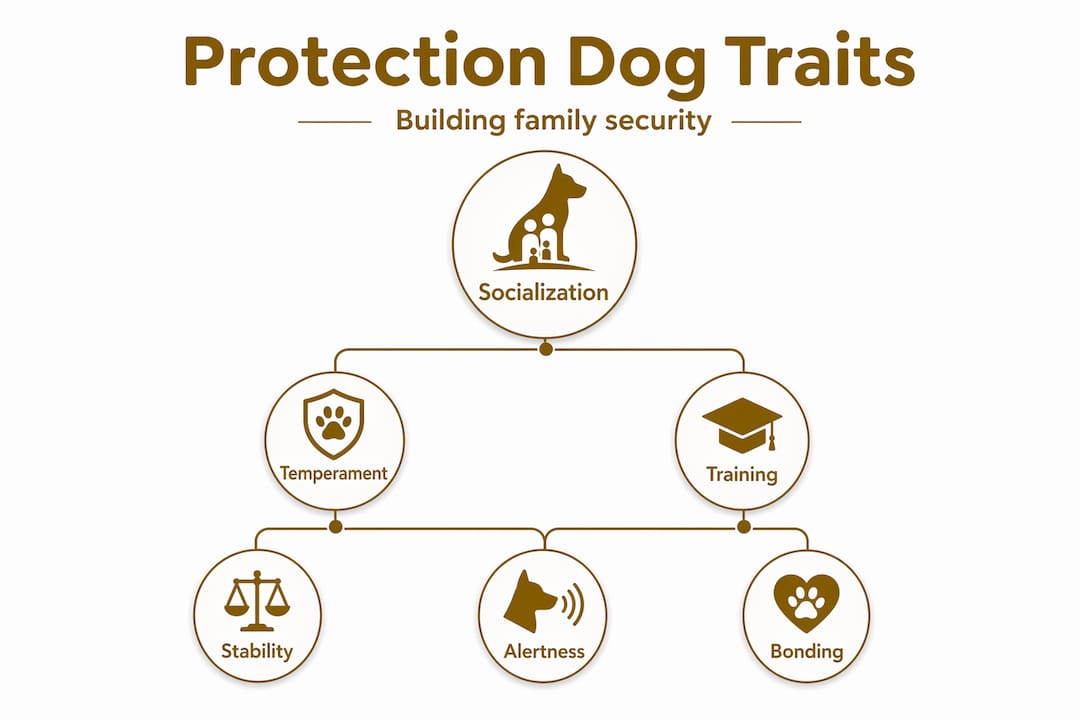
The traits of reliable family protectors consistently point back to the same foundation: socialization quality and training depth. A Doberman with a weak socialization history, regardless of its pedigree or physical capability, will not perform reliably in a complex family environment.
Pro Tip: Not all Dobermans are the same in terms of temperament or trainability. When evaluating a Doberman for family protection, prioritize documented socialization history and temperament assessments over physical appearance or lineage alone.
Can Dobermans safely live with children? Evidence and expert guidance
Now that you know what defines a Doberman family protection dog, the practical question becomes straightforward: can a properly trained Doberman actually live safely alongside children, and what does responsible ownership look like on a daily basis?
The evidence consistently shows that professional training and early socialization are the primary variables that determine safety outcomes. Dobermans that have been raised with structured exposure to children, other animals, and varied environments from an early age develop the social fluency necessary to navigate a busy household without defaulting to reactive or unpredictable behavior. The key is that this development must begin early and must be consistent throughout the dog’s life, not applied as a one-time correction.
Responsible integration of a Doberman into a home with children follows a clear progression:
- Assess the individual dog’s temperament before placement, using structured testing that evaluates responses to sudden movements, noise, and unfamiliar people.
- Establish clear household rules from day one, including designated spaces, feeding protocols, and interaction boundaries that all family members, including children, are expected to follow.
- Introduce the dog to children in controlled settings first, using calm, supervised meetings before allowing open interaction.
- Maintain consistent obedience reinforcement so the dog understands its role and responds reliably to commands during moments of excitement or unpredictability.
- Never rely on training alone as a substitute for supervision, particularly with children under eight years old, whose movements and behaviors can be genuinely startling to even a well-trained dog.
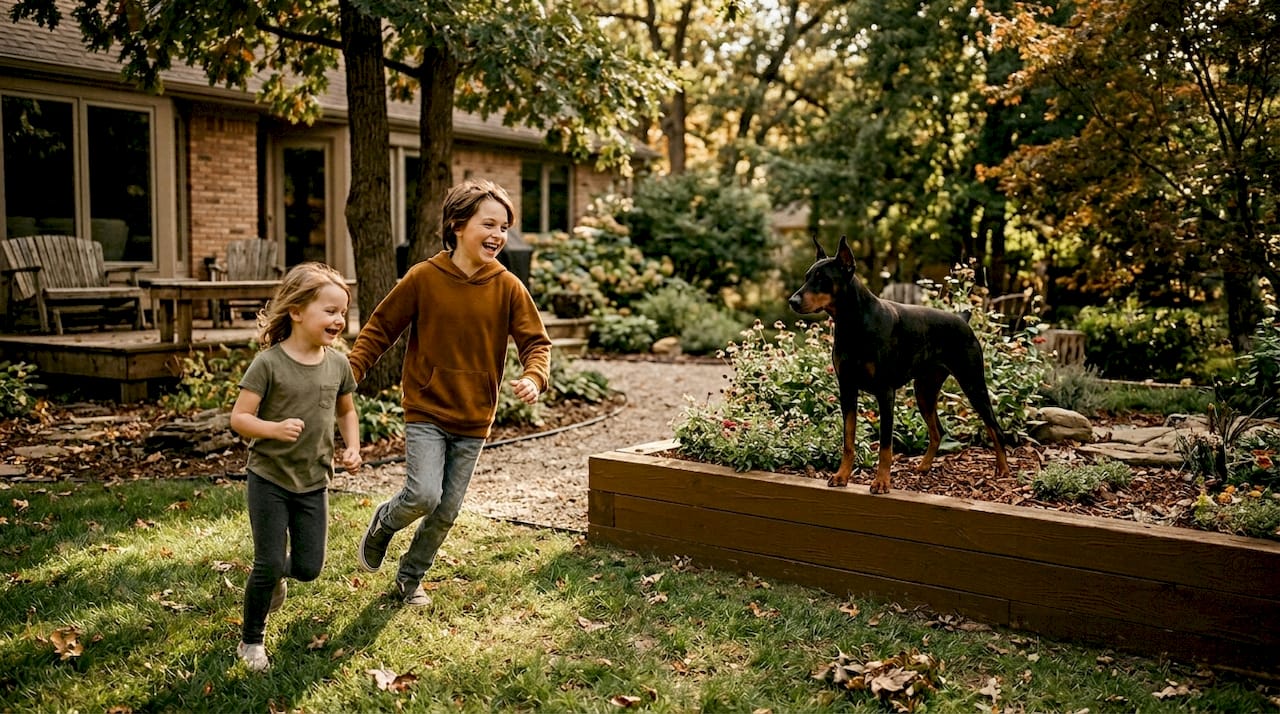
“Good with kids” depends strongly on socialization, training boundaries, and supervision. Size and energy can still create a real risk of accidental knockovers or rough handling issues, regardless of temperament quality.
This point deserves direct attention. Even a Doberman with excellent training and a stable temperament is a large, energetic animal. Accidental physical incidents with small children, not aggression, represent the most common risk in otherwise well-managed homes. Understanding this distinction shapes how families structure supervision and daily routines.
Understanding Doberman security dogs for families means accepting that the breed’s size and energy are part of the equation, and that appropriate management systems must be in place regardless of training quality.
Pro Tip: When introducing a Doberman to a new family member, including a newborn, a new household employee, or a visiting relative, treat it as a structured introduction rather than an informal meeting. Keep the dog on leash, maintain calm energy, and give the dog time to acclimate before removing oversight.
Comparing Dobermans to other protection breeds for families
Understanding Dobermans’ fit for homes with children raises the natural question: how do they compare to other protection breeds commonly considered for family security?
| Breed | Size | Energy level | Trainability | Child tolerance | Protection reliability |
|---|---|---|---|---|---|
| Doberman | Large | High | Very high | High (with training) | Very high |
| German Shepherd | Large | High | Very high | High (with training) | Very high |
| Rottweiler | Very large | Moderate | High | Moderate (with training) | High |
| Belgian Malinois | Medium | Very high | Extremely high | Moderate | Very high |
Each breed presents a distinct profile. German Shepherds are broadly versatile and widely placed in family homes with strong results, though their high energy demands considerable daily exercise and mental stimulation. Rottweilers are naturally calm in temperament but require early socialization to prevent territorial behavior from becoming difficult to manage around visitors or children’s playmates. Belgian Malinois are exceptionally capable as protection animals but carry energy levels and drive intensity that often make them a poor fit for households without professional handler experience.
Dobermans occupy a practical middle position. Their trainability and handler bonding make them highly responsive to structured development, and their temperament, when properly socialized, supports genuine warmth with family members including children. Comparing the best guard dogs reveals that no single breed is universally superior, but the Doberman’s combination of loyalty, intelligence, and adaptability consistently positions it well for family protection in high-demand households.
Several important factors should inform any honest comparison:
- Socialization investment required: All four breeds require significant early socialization, but Dobermans and Belgian Malinois particularly need it to prevent their natural alertness from developing into reactive behavior.
- Owner commitment and experience: The top protection dog breeds consistently perform best when owners are actively engaged in ongoing training maintenance, not passive participants in the dog’s development.
- Unverified marketing claims: It is worth noting that some family protection content markets protection dogs using unverified success rate metrics that do not reflect real family outcomes. Buyers should request documented training records and independent temperament assessments rather than relying on percentage claims or marketing language.
- Lifestyle fit: A Doberman in an active household with space, consistent routines, and engaged owners will perform very differently than the same dog placed in a home without those conditions.
The honest answer is that no breed automatically delivers protection reliability. The differentiating factor across all breeds is the quality of the training program, the depth of socialization, and the ongoing commitment of the family to maintaining that foundation.
How to select and prepare your Doberman for reliable family protection
Once you understand the breed comparisons clearly, the practical focus becomes your own selection process and the steps required to establish genuine reliability in a family home.
Selecting the right protection Doberman involves more than choosing from available dogs. It requires a structured evaluation process that accounts for pedigree, training history, and individual temperament testing under real-world conditions.
- Review documented training and socialization history covering the dog’s development from puppy through current stage, with specific attention to how protection instinct has been shaped and controlled.
- Request a live temperament evaluation that places the dog in scenarios relevant to your household, including interaction with children, exposure to sudden noise, and behavior around unfamiliar adults.
- Assess the training organization’s methodology, prioritizing programs that emphasize real-world obedience and emotional stability over sport titles or demonstration performance.
- Evaluate ongoing support availability, since reputable trainers provide structured follow-up, not a single handover.
- Involve your household in the assessment process, so the dog’s response to your specific family dynamic can be observed directly before placement.
Training and socialization milestones provide a useful framework for understanding where a given dog sits in its development:
| Age stage | Key development focus | What to verify |
|---|---|---|
| 8 to 16 weeks | Early socialization, neutral exposure to environments | Documented puppy socialization records |
| 4 to 12 months | Basic obedience, controlled responses, household manners | Obedience reliability in real-world settings |
| 12 to 18 months | Protection foundation work, boundary training | Controlled protective responses, no reactive aggression |
| 18 months and beyond | Advanced integration, public neutrality, family bonding | Stability across all household scenarios |
Professional guidance on selecting a personal protection Doberman consistently emphasizes that training so protective instinct does not become aggression is among the most critical elements of the entire development process. A Doberman with a strong protective drive that has not been properly channeled represents a risk, not an asset. Supervision around young children remains a non-negotiable standard regardless of training quality, and families who treat supervision as optional are misunderstanding the responsibility involved.
Ongoing assessment of fit is equally important. As your household evolves, as children grow, as staffing changes, or as travel patterns shift, your Doberman’s behavior should be evaluated against those changes and adjusted through professional support when necessary.
The reality most Doberman protection dog buyers overlook
With the selection and preparation process outlined clearly, it is worth stepping back to address something that most families discover only after bringing a Doberman home: the gap between expectations and the actual daily work required.
High-income families who invest in protection dogs often arrive with the assumption that professional training delivers a finished, plug-and-play security solution. The dog has been trained, the paperwork is complete, and the household is therefore protected. This perspective is understandable, but it is also incomplete in ways that can lead to real problems.
A Doberman’s reliability in a family environment is not a fixed state delivered through a training program and then maintained automatically. It is an ongoing condition that depends directly on how the family interacts with the dog every day. Families that allow boundaries to erode, that are inconsistent with commands, or that fail to maintain the dog’s stimulation and exercise needs will find that even a well-developed dog begins to show behavioral drift over time.
The expectation of a completely hands-off security system is also the context in which unverified claims about trained versus untrained Dobermans tend to gain traction. When buyers are told that a trained Doberman will independently manage household security without sustained family involvement, they are being given a picture that does not reflect how these animals actually function.
Dobermans are family-capable with the right safeguards, but that capability is maintained through consistent structure, not purchased once and stored. The families who experience the most reliable results are those who see the Doberman as a living investment requiring ongoing engagement, not a static security feature. That mindset shift is arguably more important than any individual training credential the dog carries.
Find the right Doberman for your family protection needs
Understanding the full picture of what a family protection Doberman requires, from temperament and training depth to ongoing household management, puts you in a significantly stronger position to make this decision confidently.
Elite Protection Dogs works directly with high-income families and executives to identify, evaluate, and place dogs that genuinely fit the demands of real family life, not just controlled demonstration environments. Whether you are considering a Doberman specifically or want to explore protection dog options across multiple breeds, our team provides the professional consultation and documented placement process that this level of investment deserves. The benefits of professionally trained protection dogs extend well beyond basic security, including emotional stability, child safety, and travel adaptability, all of which are built into every dog we develop. Explore our current family protection dogs and take the first step toward a protection solution built around your family’s specific needs.
Frequently asked questions
Are Dobermans good with children if professionally trained?
With proper socialization, consistent supervision, and clearly maintained boundaries, many professionally trained Dobermans can live safely with children and form strong, affectionate bonds with them over time.
What are the risks of having a Doberman as a family protection dog?
The most common risks involve accidental physical incidents caused by the dog’s size and energy rather than aggression, as well as the need for active adult supervision to prevent rough handling or knockovers with small children.
How do Dobermans compare to other protection breeds for homes with children?
Dobermans are highly intelligent and loyal but require more consistent supervision than some other breeds; their suitability depends directly on training quality, socialization depth, and buyer awareness that unverified breed metrics in marketing materials rarely reflect real family outcomes.
How important is early socialization for a protection Doberman?
Early socialization is foundational to developing a safe and balanced family protector, as socialization quality determines how the dog responds to children, new environments, and unpredictable household situations throughout its life.