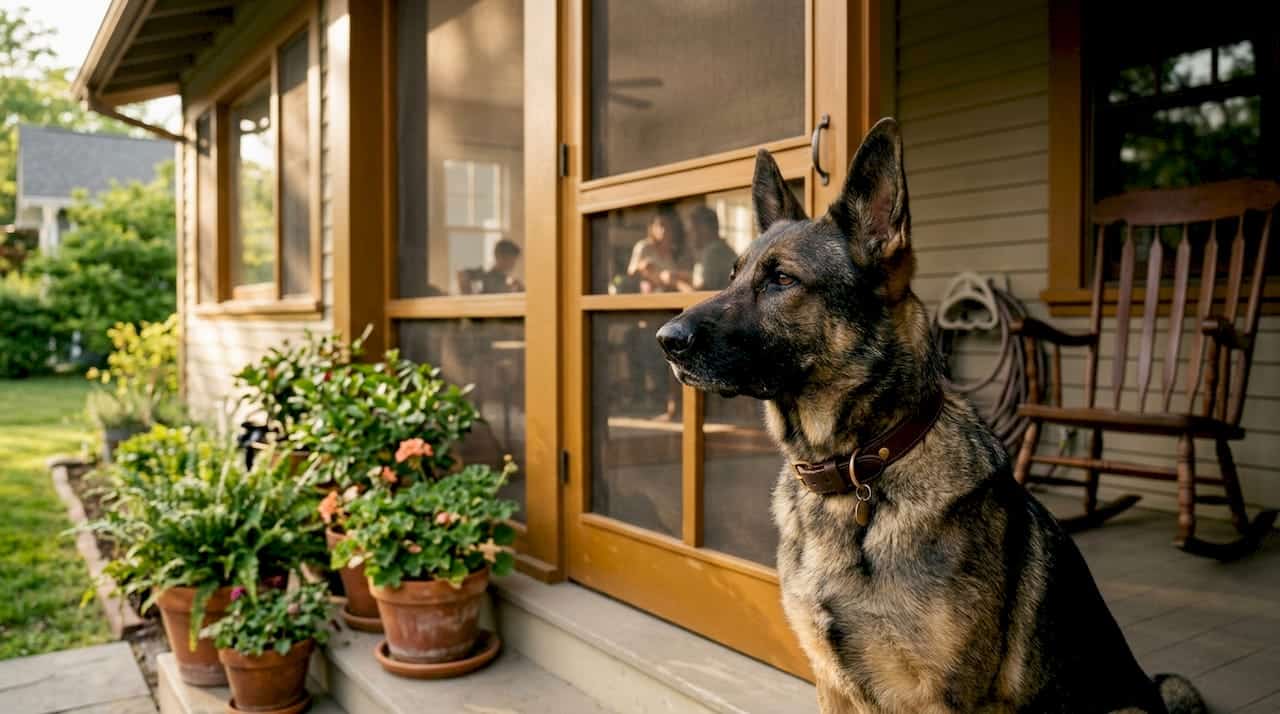
When an armed man attempted to force his way into a home in Tujunga, California, it was not an alarm panel or a security camera that stopped him. It was the family dog. The intruder retreated before law enforcement even arrived, a home invasion thwarted by the dog’s presence and response. For high-income families who understand that property and personal safety are not interchangeable concerns, this kind of outcome raises a serious question: what separates a dog that changes the outcome of a threat from one that simply barks at the mail carrier?
Table of Contents
- What makes a protection dog an intruder deterrent?
- Real-life examples of protection dog intruder deterrence
- How high-end protection dogs are trained for safe, controlled deterrence
- Limits and cautions: what protection dogs CAN and CAN’T do
- Comparison: protection dogs vs. other home security measures
- Our take: why deterrence is about psychology, not just physical protection
- Considering a protection dog for your family?
- Frequently asked questions
Key Takeaways
| Point | Details |
|---|---|
| Deterrence is psychological | A protection dog’s presence and bark often prevent crime before it happens. |
| Training ensures reliability | Top-tier protection dogs receive scenario-based training for family safety and proportional response. |
| Dogs are part of a system | For high effectiveness, integrate protection dogs with alarms and owner readiness. |
| Know the limits | Protection dogs can deter but are not a substitute for human response or layered security. |
What makes a protection dog an intruder deterrent?
Understanding deterrence requires separating perception from reality. Most people picture a protection dog as a dog that physically intervenes. In practice, the most consistent and reliable deterrence happens well before any physical contact occurs. A dog’s visible presence, audible bark, and unpredictable behavior pattern are the primary mechanisms that cause a would-be intruder to reconsider.
Security experts confirm that deterrence works primarily through visibility and psychological target selection. Criminals, particularly opportunistic burglars, evaluate risk before committing to a target. A property with a clearly present, alert dog signals elevated risk and reduced control. Most intruders will simply move on.
The benefits of professionally trained protection dogs extend beyond the bark itself. A well-developed dog provides early warning that gives the owner critical response time. That window, even if it is only 30 to 60 seconds, is often the difference between a family reaching safety and being caught off guard.
Key deterrence mechanisms include:
- Visible presence: A dog seen through a window or in a yard signals immediate, unpredictable risk.
- Audible alert: Barking draws attention, alerts the household, and disrupts a criminal’s need for silence.
- Psychological unpredictability: Unlike an alarm, a dog’s behavior cannot be easily predicted, timed, or bypassed.
- Physical capability: A trained dog can physically intervene if necessary, adding a layer of genuine physical deterrence.
- Owner response time: Early warning allows the family to call authorities, reach safe rooms, or arm themselves.
“A dog’s bark is often enough to cause an intruder to abort. The goal is not necessarily a physical confrontation but an outcome where the threat is removed before harm occurs.”
For families considering this investment, it is worth understanding that trained protection dogs for sale at the elite level are developed specifically to maximize these deterrence mechanisms through structured, scenario-based preparation, not reactive aggression.
Real-life examples of protection dog intruder deterrence
Now that you understand what makes a dog a deterrent, it is worth examining what that looks like in documented, real-world situations.
- Tujunga, California home invasion attempt: An armed man attempted to force entry into a residential home. The family dog responded immediately, and the intruder fled before police arrived. The dog’s response time and presence were the deciding factors in preventing what could have been a violent confrontation.
- Pit bull holds intruder at bay for 20 minutes: In a widely reported incident, a family dog physically cornered an intruder and held him in place for approximately 20 minutes until law enforcement arrived. The dog did not cause serious injury but maintained control of the situation effectively.
- Suburban deterrence through visible presence alone: Multiple documented cases involve intruders who bypassed homes after observing a large dog through a window or in a yard, choosing instead to target a neighboring property without a dog. These cases rarely make headlines but represent the most common form of canine deterrence.
“The outcome in Tujunga reinforced what protection specialists have long understood: early warning and psychological deterrence are the most reliable outcomes of a well-placed protection dog.”
Key statistic: Properties with dogs present are statistically less likely to be targeted by burglars. Studies examining criminal behavior consistently show that the presence of a dog, particularly a large or vocal one, ranks among the top factors that cause offenders to abandon a target.
What worked in each of these cases was not random aggression. It was a combination of alert behavior, physical presence, and a dog that was confident enough to respond without hesitation. The family safety investment with protection dogs is precisely this: a dog developed to respond reliably, not erratically.

The limitations are also worth noting. In cases where intruders were armed and determined, a dog alone was not always sufficient to prevent harm. Dogs can be injured. They cannot call for help. And without proper training, their responses can be inconsistent or misdirected.
How high-end protection dogs are trained for safe, controlled deterrence
Effective deterrence is rarely accidental. The dogs that consistently produce reliable outcomes are the product of structured, long-term development that prioritizes both effectiveness and safety.
Elite protection dog training typically follows a progression that begins with foundational obedience and socialization, then advances through scenario-based work that simulates real-world threat conditions. This is not sport training. It is practical preparation designed to produce controlled, proportional responses in unpredictable environments.
A critical component of high-end training is what practitioners call the “on/off switch.” A properly developed dog can be fully engaged in a protective response and then immediately stand down on command. This level of control is what separates a genuinely useful protection dog from a liability. Compliance in security training is a principle that applies equally to human security personnel and canine assets.
| Feature | Poorly trained dog | Elite, scenario-trained dog |
|---|---|---|
| Response consistency | Unpredictable, reactive | Reliable, calibrated |
| Family safety | Risk of misdirected aggression | Stable around children and guests |
| Command compliance | Selective or delayed | Immediate and consistent |
| Scenario readiness | Responds to familiar triggers only | Adapts to novel environments |
| Off-switch | Absent or unreliable | Fully functional on command |
| Socialization | Limited or stressful | Broad, stable, and confident |
The methodology described by elite protection dog vendors emphasizes that the training process typically spans one to two years and encompasses far more than bite work. Obedience, emotional stability, environmental exposure, and handler communication are all developed in parallel.
Pro Tip: Before purchasing any protection dog, ask to observe the dog in a live scenario training session. A reputable provider will welcome this request. If they hesitate, that hesitation tells you something important about the dog’s actual readiness.
Limits and cautions: what protection dogs CAN and CAN’T do
To make the most of a protection dog and avoid false expectations, understanding their realistic boundaries is essential. Families who approach this investment with clarity will be better positioned to integrate the dog effectively into a broader safety plan.
What protection dogs can do reliably:
- Provide early warning through alert barking before a threat reaches the home
- Deter opportunistic intruders through visible presence and unpredictable behavior
- Physically intervene when trained to do so and when the situation warrants it
- Offer a mobile, adaptable layer of security that travels with the family
- Provide a psychological sense of safety that passive systems cannot replicate
What protection dogs cannot do:
- Distinguish every nuance of criminal intent with perfect accuracy
- Call for emergency assistance independently
- Guarantee physical safety against armed, determined, or multiple attackers
- Replace human judgment in complex or ambiguous threat scenarios
- Operate without consistent handling, ongoing training, and proper management
Dog protection training safety professionals consistently caution that dogs should not be positioned as the sole security measure in any household, particularly one with complex risk profiles. Liability is a real concern. If a protection dog injures a person, even in a defensive context, the legal consequences vary significantly by jurisdiction and circumstance.
Pro Tip: Integrate your protection dog as one layer within a broader security plan that includes monitored alarm systems, access control, and clearly defined household protocols. The dog’s role is to provide early warning and a credible physical deterrent, not to serve as the entire defense strategy.
Off-leash control in protection dogs is a non-negotiable standard for any dog operating in a family environment. Without it, the dog’s protective capability becomes a liability rather than an asset.
Comparison: protection dogs vs. other home security measures
For families serious about safety, it helps to see how protection dogs compare alongside other top-tier security options before making a final decision.
| Security measure | Deterrence effectiveness | Response speed | Annual cost range | Liability risk | Family suitability |
|---|---|---|---|---|---|
| Trained protection dog | Very high | Immediate | $15,000 to $60,000+ | Moderate | Very high |
| Monitored alarm system | Moderate | 3 to 10 minutes | $500 to $3,000 | Low | High |
| Private security guard | High | Immediate on-site | $50,000 to $150,000+ | High | Moderate |
| Security cameras | Low to moderate | Reactive only | $1,000 to $10,000 | Very low | High |
Security experts note that no single measure provides complete protection. The most effective security posture combines multiple layers, each compensating for the weaknesses of the others.
Scenarios where a protection dog clearly excels:
- Residential environments where the family is present and the dog can respond in real time
- Travel situations where the family moves between locations and needs portable protection
- Households with children who benefit from a companion that doubles as a deterrent
- Properties where alarm response times are long due to remote location or slow law enforcement availability
Scenarios where alternatives may complement the dog:
- Commercial or high-traffic environments where a dog’s presence creates management complexity
- Situations requiring 24-hour monitored coverage when the family is away for extended periods
- Properties with specific access control requirements that benefit from electronic systems
For a direct analysis of how trained guard dogs compare to security guards, the differences in mobility, cost, and family integration make the protection dog a compelling option for most residential applications.
Our take: why deterrence is about psychology, not just physical protection
The most persistent misconception in this space is that a protection dog’s value is measured by its willingness to bite. That framing misunderstands how deterrence actually functions and leads families toward the wrong criteria when evaluating a dog.
The evidence is consistent. Early warning and psychological deterrence are the outcomes that matter most in the vast majority of real-world incidents. A dog that causes an intruder to abandon a target before entering the property has done its job completely. No physical intervention required.
What produces that outcome is not raw aggression. It is confidence, stability, and visible readiness. A dog that is calm in daily life but alert and decisive under pressure communicates something that no alarm system can replicate: genuine, unpredictable capability. Criminals understand this distinction instinctively, even if homeowners sometimes do not.
The families we work with who experience the most consistent safety outcomes are those who treat the protection dog as a central component of a layered plan, not as a standalone solution. They invest in proper training, maintain handler skills, and integrate the dog into realistic household protocols. The dog’s psychological impact on potential threats is amplified precisely because the dog is well-managed, visible, and clearly capable.
Unrealistic expectations, on the other hand, create real risk. A family that relies entirely on a dog without alarm backup, without household protocols, and without ongoing training is not protected. They are simply hopeful. Family safety solutions that work are built on planning, not assumptions.
Considering a protection dog for your family?
If the evidence in this article has clarified the genuine value that a professionally developed protection dog can bring to your household, the next step is selecting the right dog from a source that holds itself to the highest standards of development and transparency.

Our elite protection dogs are developed through one to two years of intensive, scenario-based preparation focused on real-world obedience, emotional stability, and reliable deterrence. Every dog is evaluated for family suitability, socialization quality, and handler compatibility before placement. When you explore protection dog options, you will find dogs that are ready for both family life and genuine protection. If you are new to this investment, learning what a family protection dog actually is will help you ask the right questions. You can also browse our available protection dogs to see current placements and individual profiles.
Frequently asked questions
Do protection dogs always confront intruders physically?
Most deterrence comes from barking, visible presence, and alerting the household. Physical intervention is rare but possible with properly trained dogs when the situation warrants it.
Can a family protection dog be both safe and effective around children?
With professional selection and scenario-based training, high-end dogs are developed for both reliable protection and stable family integration. Elite vendors emphasize that family safety and protection effectiveness are not competing priorities when the dog is properly developed.
Do professional protection dogs reduce home break-ins compared to other security systems?
Homes with dogs show lower burglary rates than comparable homes without them, though the strongest outcomes come from integrating a protection dog with monitored alarms and defined household security protocols.
What are the liabilities of owning a protection dog?
Dog owners may face legal and financial liability if their dog injures a person, even in a defensive context. Liability and operational constraints vary by jurisdiction, so consulting qualified trainers and local legal counsel before placement is strongly recommended.
Recommended
- Fully Trained Guard Dogs for Reliable Property Protection
- Why a Protection Dog is Your Family’s Best Defense – Elite Protection Dogs
- Advantage of Investing in a Professionally trained Personal Protection Dog – Elite Protection Dogs
- Professional Protection Dogs for Home Security: Trusted Family Safety Solutions
Several of the incidents above happened in Southern California — an area where we regularly place trained dogs. See our protection dogs for sale in Los Angeles.