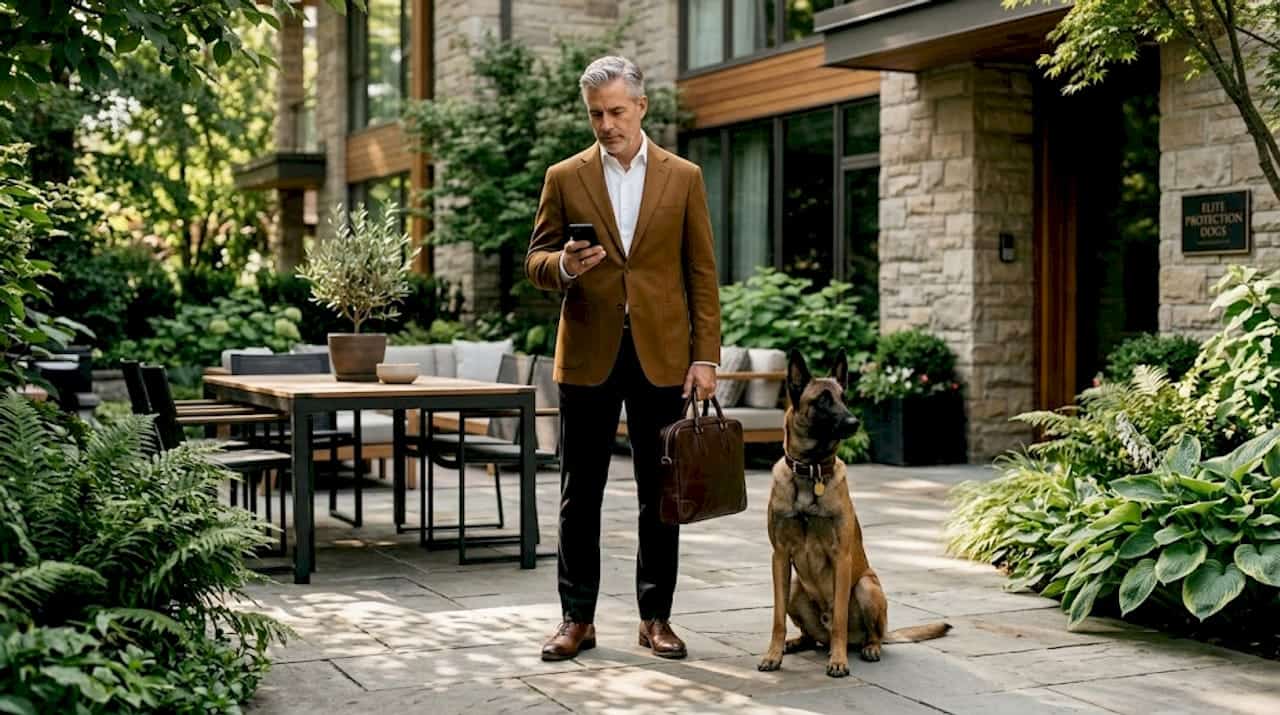
Unlike alarm systems or security cameras, a well-trained protection dog is not passive. It moves with you, reads a room, and responds in real time, qualities no electronic device can replicate. Protection dogs for public figures explained through the lens of serious personal security reveals a discipline far more structured and demanding than most people expect. This guide covers everything high net worth individuals and families need to know: training tiers and their real-world capabilities, breed selection, cost ranges, public behavior standards, and how to integrate a protection dog successfully into your household and travel routines.
Table of Contents
- Understanding protection dog training levels and capabilities
- Breed selection and behavioral traits for high-net-worth owners
- Protection dogs in public: behavior, handling, and etiquette
- Integrating protection dogs into high-net-worth family lifestyles
- Protection dog costs, logistics, and acquisition due diligence
- Why approaching protection dogs as strategic security partners matters most
- Explore top-tier protection dogs tailored for your security needs
- Frequently asked questions
Key Takeaways
| Point | Details |
|---|---|
| Protection dog training tiers | Protection dogs range from basic family companions to elite executive-level trained for multiple handlers and travel. |
| Breed suitability | Belgian Malinois, German Shepherds, and Dutch Shepherds are the preferred breeds for high-level protection dog work. |
| Public behavior expectations | Protection dogs remain fully focused while working and should not be distracted by petting or casual interaction. |
| Humane training methods | Positive reinforcement improves dog reliability and welfare compared to forceful training techniques. |
| Cost considerations | Prices vary widely based on training level and pedigree, with executive dogs costing up to six figures, including health and delivery services. |
Understanding protection dog training levels and capabilities
Protection dogs are not a monolithic category. The difference between a dog trained for basic personal protection and one prepared for executive-level security is significant, and understanding those distinctions is the foundation for making the right investment.
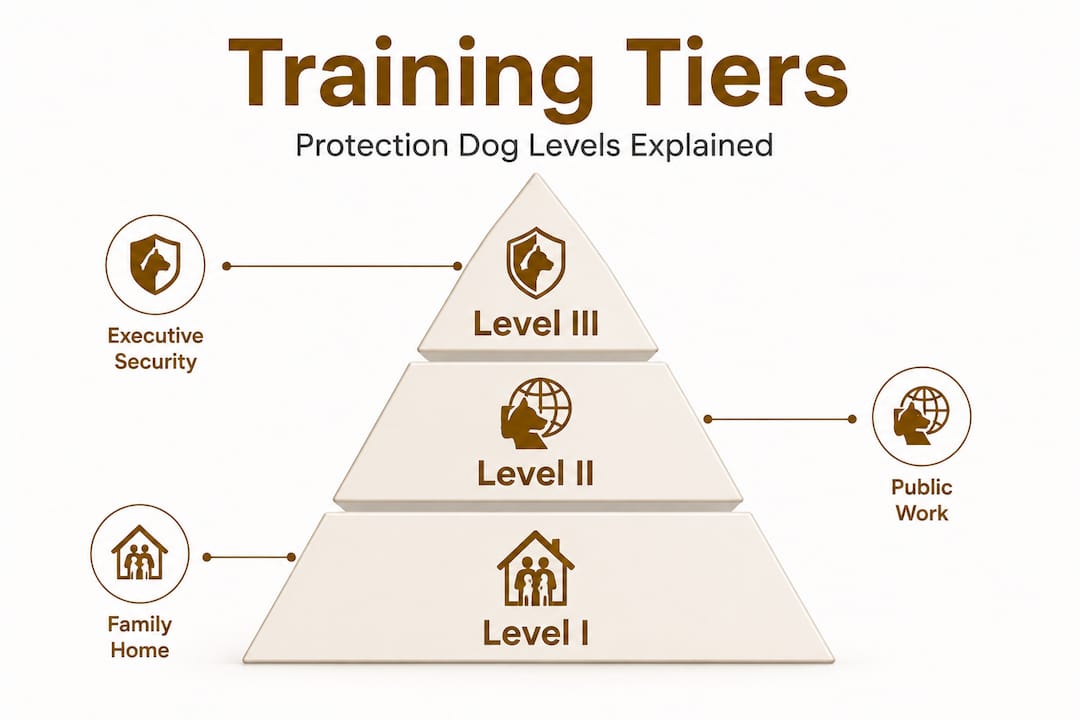
The industry generally recognizes three tiers of capability:
- Level I dogs provide foundational obedience and a credible deterrent presence. They are ideal for families seeking added peace of mind in residential settings.
- Level II dogs incorporate bite work, controlled threat response, and reliable protection in family environments. These dogs are trained to respond to direct threats while remaining manageable around children and household staff.
- Level III dogs represent the highest capability. They are conditioned for high-pressure, unpredictable environments, including crowded venues, international travel, and close-protection work alongside human security teams.
For public figures specifically, Level III is where the conversation typically begins. Executive protection dogs are trained for travel readiness and multi-handler capability, including integration with security staff and resilience in unfamiliar environments such as crowds and high-stress settings. That is a meaningfully different standard than what most buyers assume when they hear the term “trained protection dog.”
Training at this level incorporates three distinct disciplines: foundational obedience, progressive bite work with controlled engagement and release, and scenario-based drills in real-world environments such as hotels, airports, and public events. The scenario work is particularly important because it builds the kind of emotional stability that prevents a dog from becoming a liability in complex, high-stimulation situations.
| Training level | Primary environment | Typical capabilities | Best suited for |
|---|---|---|---|
| Level I | Residential | Obedience, deterrence | Families, basic protection |
| Level II | Family and light travel | Bite work, family protection | HNW families with children |
| Level III | Executive, travel, events | Multi-handler, crowd composure, advanced threat response | Public figures, executives, celebrities |
If you want to explore best personal protection dogs for your specific circumstances, the training tier is the first variable to evaluate before breed or price.
Pro Tip: Ask any prospective provider to demonstrate the dog’s level of obedience under distraction before discussing price. A dog that breaks command focus when a stranger approaches is not functioning at the level you are paying for.
Breed selection and behavioral traits for high-net-worth owners
Understanding training levels enables informed decisions about which breeds align with your protection and family needs, and the breed conversation matters more than many buyers initially realize.
Three breeds consistently do the heavy lifting in professional programs: Belgian Malinois, German Shepherd, and Dutch Shepherd, due to their work ethic, trainability, and temperament. Each has a distinct profile worth understanding before you commit.
- Belgian Malinois are the breed of choice for elite military and law enforcement programs globally. They are high-drive, fast, and relentlessly athletic. In the right handler’s hands, they are exceptional. For a family with very young children and limited dog experience, they require careful consideration and thorough evaluation.
- German Shepherds offer a more versatile temperament. They are highly trainable, deeply loyal, and generally calmer in home environments than a Malinois, making them a common recommendation for families where the dog needs to transition naturally between protection work and everyday companionship.
- Dutch Shepherds sit between the two in many respects. They carry strong working drive with a temperament that tends to be more manageable in residential settings. Increasingly popular among executives and security-conscious families who want capable protection without the intensity of a full Malinois.
The critical variable that rarely gets discussed is lifestyle fit. A high-drive Belgian Malinois placed in a sedentary household, or with an owner who cannot provide consistent mental and physical engagement, will underperform and potentially create behavioral problems. The best breed for you is not necessarily the most impressive on paper. It is the one that aligns with your household’s activity level, family composition, and handler experience.
When choosing a family protection dog, be cautious of providers who market breeds without demonstrated specialization in protection work. Breed alone does not guarantee capability.
Pro Tip: Request video documentation of the specific dog, not just the breed, working through realistic scenarios. Watching a dog maintain controlled composure during a simulated threat near a child tells you far more than any pedigree certificate.
Protection dogs in public: behavior, handling, and etiquette
With breed considerations covered, understanding how these dogs function in real-world public settings is essential for maintaining the security they are trained to provide.
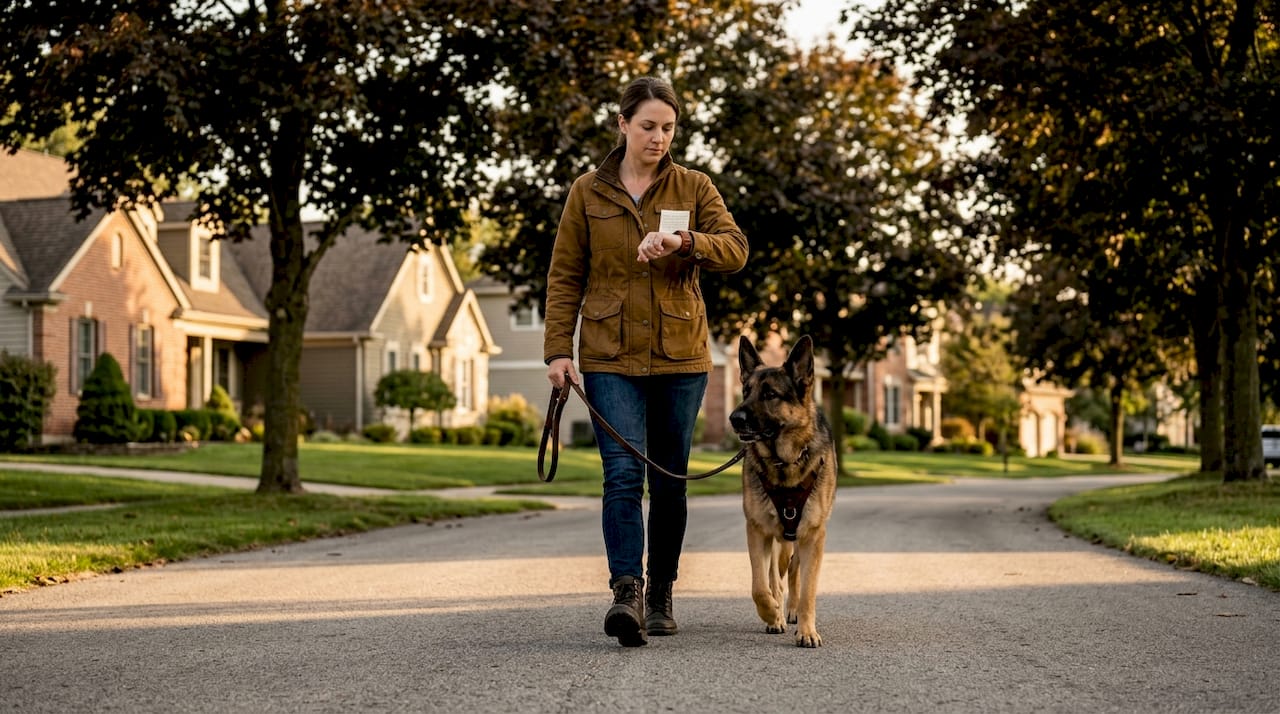
A protection dog working in public is not a pet on an outing. It is a working professional operating in an environment that demands sustained attention and controlled responses. This distinction shapes every aspect of how handlers and bystanders should interact with the dog while it is on duty.
Working dogs in public must stay locked on their job, and even brief distractions like petting can break their focus, affecting security effectiveness. This is not a minor technical point. It is a practical reality that public figures and their staff need to communicate clearly to anyone in proximity to the dog.
A trained protection dog scanning a crowd is not being unsocial. It is doing precisely what it was developed to do: monitoring for behavioral anomalies, tracking movement patterns, and maintaining positional awareness relative to its principal.
Key behaviors you can expect from a properly trained protection dog working in a public setting include:
- Neutral public demeanor: the dog does not engage with strangers unless a threat response is warranted.
- Sustained positional awareness: it remains oriented toward its principal, not toward environmental novelties.
- Crowd composure: elevated noise, movement, and unpredictability do not cause reactive behavior.
- Handler responsiveness: the dog is continuously responsive to its handler’s commands even in high-distraction environments.
Anyone working alongside a public figure’s protection dog, whether personal staff, event security, or household members, should receive a brief orientation from the handler. Understanding when the dog is working versus when it is in a social mode is a practical safety consideration, not a formality.
Understanding what to expect from a trained protection dog before bringing one into your security program prevents costly misunderstandings.
Integrating protection dogs into high-net-worth family lifestyles
Understanding public behavior sets the foundation. Now the practical strategies for integrating a protection dog into your family’s day-to-day security program require the same level of diligence as selecting the dog itself.
A protection dog is not a static asset. Its effectiveness is directly tied to the quality and consistency of its ongoing relationship with your household, your handlers, and your broader security team. For HNW individuals, a protection dog is an integrated component of a physical security program where diligence, temperament matching, and structured onboarding are critical.
The integration process, when done correctly, follows a clear progression:
- Pre-placement assessment: evaluate your household’s daily routines, travel frequency, presence of children or other pets, and staff interaction patterns before selecting a dog.
- Structured introduction period: the dog should be introduced to the home environment gradually, with handler support present during the early weeks to establish consistent behavioral expectations.
- Handler training for the principal: you and your household members need to understand command protocols, boundary-setting, and how to read the dog’s behavioral signals accurately.
- Integration with existing security measures: the protection dog’s role within your broader security program should be clearly defined, including how it interacts with physical security staff and any residential security systems.
- Ongoing training maintenance: protection skills and obedience standards degrade without regular reinforcement. Budget for scheduled maintenance sessions with a qualified trainer.
Training methodology also deserves attention. Humane, positive reinforcement approaches reduce stress and injuries, improve reliability and trust between dogs and handlers, and should be prioritized. A dog trained through compulsion-based methods may perform under controlled conditions but can become unpredictable under real stress. Methods grounded in positive reinforcement produce more reliable, cooperative working dogs.
Understanding why to buy a personal protection dog also means accepting that these animals complement physical security infrastructure rather than replace it. Cameras, access control, and human security staff remain important. The protection dog fills the gaps those systems cannot: real-time threat detection, mobile protection, and an active deterrent that travels with you.
Pro Tip: Schedule a “handler day” with your provider before bringing the dog home. A single day of structured, hands-on training with the trainer present dramatically reduces the adjustment period and builds your confidence as the primary handler.
Protection dog costs, logistics, and acquisition due diligence
Having explored lifestyle integration, understanding the financial and logistical realities prepares you to make a confident, well-informed decision.
Cost is one of the most misunderstood aspects of acquiring a protection dog, and misaligned expectations at the outset lead to poor purchasing decisions. Level I dogs typically start in the mid-five figures, Level II dogs range from $35,000 to $75,000, and Level III executive dogs can cost $80,000 to the low six figures, including import fees and thorough health vetting.
| Training level | Typical price range | Key cost drivers |
|---|---|---|
| Level I | $15,000 to $30,000 | Basic obedience, deterrence training |
| Level II | $35,000 to $75,000 | Bite work, family integration, advanced socialization |
| Level III | $80,000 to $120,000+ | Import, multi-handler prep, executive scenario training |
Before committing to any purchase, due diligence should follow a structured process:
- Verify lineage and health documentation: request hip and elbow certifications, genetic health testing results, and vaccination records from an independent veterinarian.
- Observe a live demonstration: watch the specific dog perform obedience commands, threat response, and public composure in a real environment, not a staged kennel demonstration.
- Confirm handler transition support: the provider should offer structured handover training, not simply a delivery and departure.
- Request client references: reputable providers maintain long-term relationships with clients and should be able to connect you with past buyers willing to speak candidly.
- Clarify return and support policies: understand what happens if the dog does not adapt to your household, and whether ongoing training support is included or priced separately.
The protection dog investment costs reflect years of development, health management, and professional training. Treating this purchase like a consumer transaction rather than a professional hire will almost always result in a poor outcome.
Pro Tip: If a provider is reluctant to allow an independent veterinarian to examine the dog before purchase, treat that hesitation as a serious warning sign.
Why approaching protection dogs as strategic security partners matters most
Here is a perspective that the standard buyer’s guide tends to skip: most problems with protection dogs in high net worth households are not dog problems. They are expectation problems.
Families spend months selecting the right estate management software or vetting household staff, then expect a protection dog to integrate and perform with minimal preparation. That approach fails, not because the dog was inadequately trained, but because the household was not prepared to receive it.
For executives and HNW families, a protection dog is not a substitute for a physical security program; it is a high-value, integrated component treated like an executive hire. That framing changes everything. An executive hire receives onboarding, clear role definition, performance expectations, and regular evaluation. A protection dog requires the same institutional treatment.
The advantage of investing in a professionally trained dog over any electronic alternative is that the dog is adaptive and present. It responds to ambiguity, reads social dynamics, and provides an active deterrent that moves with the principal through airports, hotel lobbies, school drop-offs, and private events. No camera system does that. No alarm does that.
The practical implication is this: your investment in a Level III protection dog is only as strong as your household’s willingness to maintain training standards, respect handler-dog protocols, and treat the animal as a working professional rather than an expensive novelty. Families who make that commitment report a measurable, lasting improvement in their sense of personal security. Families who do not often find themselves with an underperforming dog and a difficult conversation with their provider.
Approach this decision with the same rigor you would apply to any high-stakes executive decision, and the result is genuinely transformative.
Explore top-tier protection dogs tailored for your security needs
For families and principals ready to move beyond general research and into real selection, the quality of the provider matters as much as the quality of the dog. Our elite personal protection dogs are developed through one to two years of intensive, hands-on training focused on real-world obedience, emotional stability, and reliable protection across all environments.
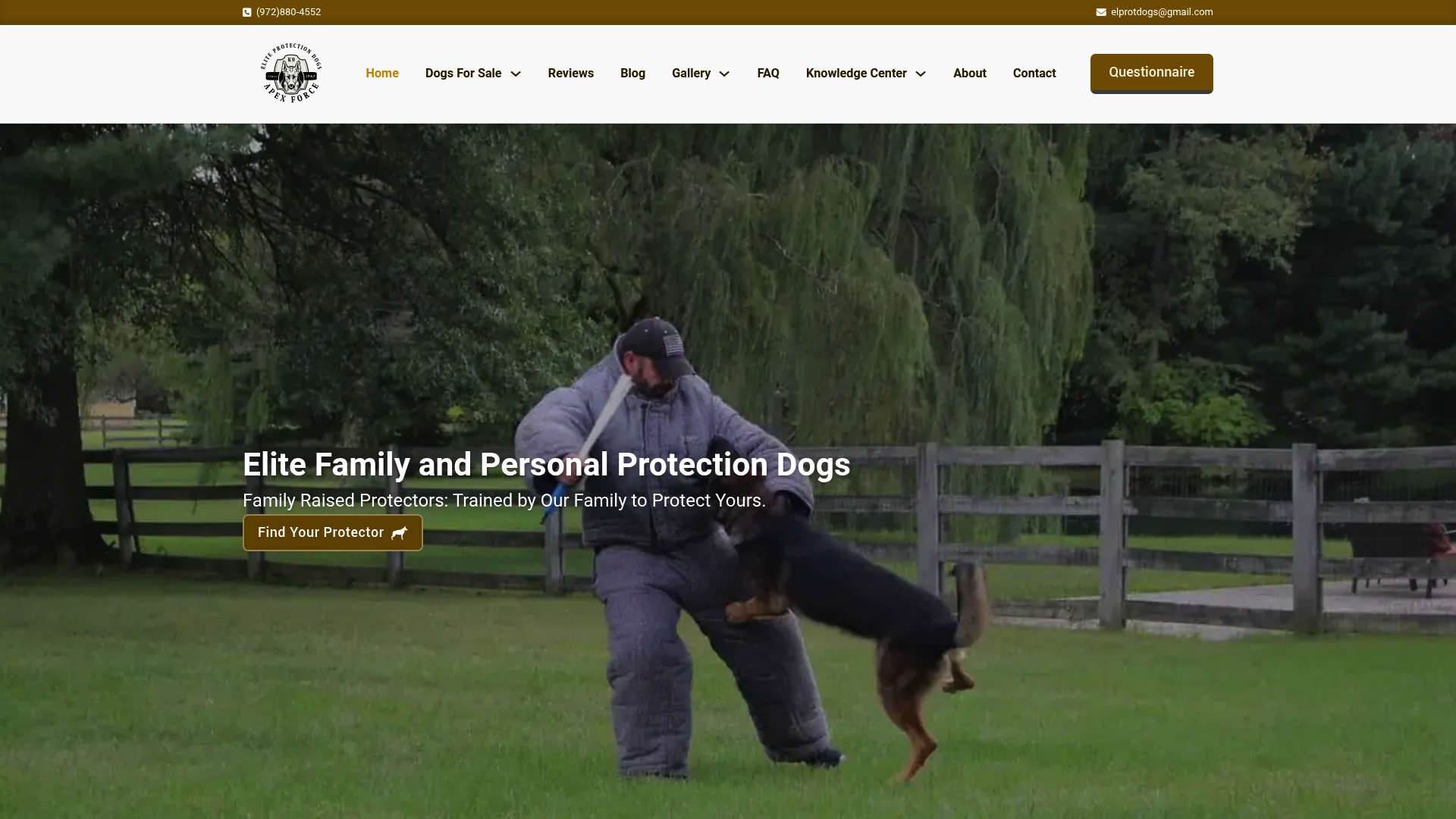
Every dog we place is thoroughly vetted for health, lineage, and demonstrated performance, then matched to your household through a detailed consultation process. We work with families, executives, and public figures who require a dog that functions as a trustworthy companion and a dependable protector without compromise. Our protection dogs available for placement come with structured handover training and ongoing support. If you are beginning the selection process, our guide to choosing a family protection dog is an excellent starting point for clarifying your household’s specific requirements.
Frequently asked questions
What are the main training levels for protection dogs and how do they differ?
Protection dogs are generally classified into Level I (basic companion and deterrence), Level II (family protection with trained bite work), and Level III (executive protection with multi-handler and travel capabilities). Each level reflects a significant increase in skill complexity, conditioning depth, and suitability for demanding or high-risk environments, as training standards for each tier make clear.
Can protection dogs stay focused in busy public areas?
Yes, properly trained protection dogs maintain sustained focus on their duties in public settings, ignoring ambient distractions even in crowded or high-stimulation environments. This is why handlers and bystanders should avoid petting or engaging working dogs, as even brief distraction can disrupt a dog’s security effectiveness.
Why is positive reinforcement training important for protection dogs?
Positive reinforcement reduces stress and the risk of injury during training, builds genuine trust between the dog and handler, and produces more reliable obedience under real-world pressure. As research on working dog training confirms, humane methods improve both performance and long-term handler-dog cooperation.
What factors influence the cost of a protection dog?
Cost is shaped by training level, breed, bloodline quality, country of origin, health testing, and import logistics. Level III executive protection dogs typically range from $80,000 to over $100,000, reflecting their advanced preparation, as detailed pricing breakdowns for each tier confirm.